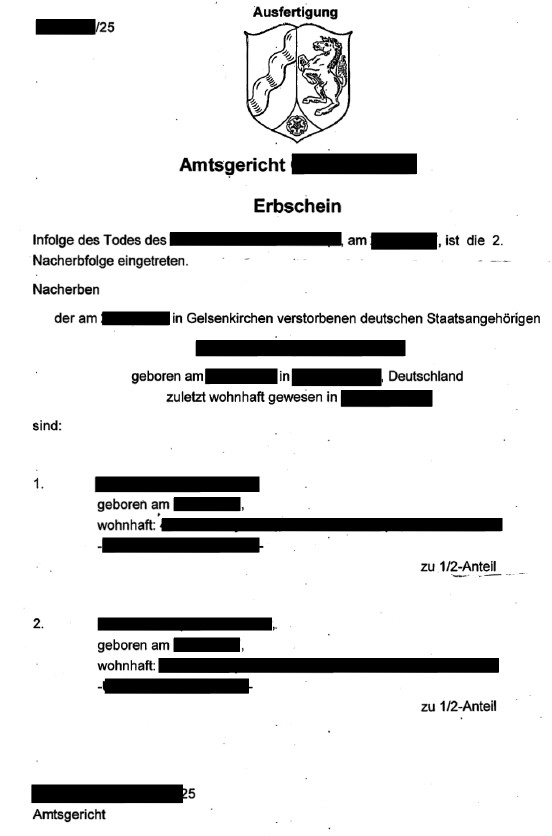
Why You Need a Certificate of Inheritance (Erbschein) & How to Get It

When a loved one dies owning property in Germany, heirs, especially those residing in the United States often find themselves overwhelmed by the legal complexities of accessing the estate. A central requirement in these cases is the Erbschein, or Certificate of Inheritance. This court-issued document formally establishes who the legal heirs are under German law and is essential for transferring real estate, closing bank accounts, and accessing other assets. Without it, heirs typically cannot act on behalf of the estate, making the Erbschein not only a formality but a legal necessity.
Securing an Erbschein is not a simple process. It requires petitioning the German probate court (Nachlassgericht) and submitting extensive documentation, including translated and apostilled death certificates, wills, or proof of intestate succession. The process can take months, particularly if the heirs are abroad or if there are complications such as handwritten wills (Testamente) or disputes between heirs. Errors or delays in filing can stall access to property and even risk penalties for unpaid inheritance taxes. That’s why strategic legal guidance is crucial from the outset.
Here is step by step guide on how to obtain a certificate of inheritance:
1. Confirm you actually need an Erbschein (and what for).
In practice, German land registries and banks will not accept U.S. probate papers. They require a German Erbschein (or a German executor’s certificate) to transfer real estate or release bank funds. The Erbschein is issued by the German probate court (Nachlassgericht).
2. Identify the competent probate court (Nachlassgericht).
Jurisdiction is the Amtsgericht (local court) where the decedent last had their gewöhnlicher Aufenthalt (habitual residence). If there was no residence in Germany, jurisdiction can depend on the location of assets.
3. Choose the right application path (from the U.S. or in Germany).
You can have the application and the required affirmation in lieu of oath (eidesstattliche Versicherung) recorded (a) at the competent Nachlassgericht in Germany, (b) by a German notary, or (c) by a German consular officer abroad, who forwards the notarized record to the court.
4. Determine your basis of inheritance and the Erbschein type.
The court needs to know whether you inherit by statute (gesetzliche Erbfolge) or will (gewillkürte Erbfolge), whether you’re sole heir, co-heir, or need a partial/quoten Erbschein. The statutory content requirements for the application are set out in § 352 FamFG.
5. Assemble the documents (with translations/apostilles as needed). Typical set:
Death certificate (preferably international/multilingual); U.S. certificates generally need apostille + certified German translation.
Proof of kinship (birth/marriage certificates) for statutory succession; or the will (with probate opening protocol if available) for testamentary succession.
Photo ID/passport copies, addresses of all known heirs, and information about any predeceased heirs.
6. Prepare the application content exactly as the statute requires.
§ 352 FamFG lists the data points you must provide (time of death; last habitual residence and nationality; basis of heirship; persons whose rights could exclude/reduce your share; etc.). The court will require public documents for some items and an eidesstattliche Versicherung for others.
7. Record the application + oath and file it.
In Germany: appear at the Nachlassgericht or a notary to have the application recorded; the clerk/notary will take your sworn statement and forward everything to the court. From the U.S.: book a German consulate appointment; they will record your application/affidavit and you (or your representative in Germany) submit to the competent court.
8. Pay advance court/notary costs (GNotKG).
Fees are statutory and depend on the estate value (reiner Nachlass). Expect one fee for the Erbschein proceeding and another for the sworn statement; amounts scale with value (fee table per GNotKG).
9. Court examination and decision.
The Nachlassgericht investigates ex officio (Amtsermittlung), issues a decision (Beschluss) establishing the facts, and then issues the Erbschein; if requirements aren’t met, it rejects the application. The Erbschein creates a rebuttable presumption of heirship relied on by third parties.
10. Use the Erbschein to administer assets.
Present it to the Grundbuchamt to register title for real estate and to banks/insurers to access funds. Foreign probate grants are typically not accepted in lieu of an Erbschein.
If this seems overwhelming, contact us. The German American Law Center, PLC, located in Michigan, works closely with its partner office, Rechtsanwaltskanzlei PECHER in Germany, to help American families navigate this cross-border process efficiently. Attorney Mandy Pecher, Esq., LLM., MBA, who is licensed in both Germany and the United States, leads a bilingual legal team that bridges the legal and linguistic divide between the two countries. Our firm routinely handles Erbschein applications and guides heirs through the procedural and cultural nuances of German probate law.
The German American Law Center has the ability to act on your behalf both in the United States and in Germany. Whether you're dealing with a complex estate or simply need guidance with your application, we handle everything from gathering and translating documents to coordinating with the German court and notaries. Our dual-licensed practice eliminates the need for clients to travel to Germany, saving significant time and cost while maintaining full legal compliance.
If you are the heir to German assets, don’t wait until legal problems mount. Securing a Certificate of Inheritance early can prevent serious financial and legal setbacks.
Contact the German American Law Center PLC or Rechtsanwaltskanzlei PECHER today to schedule a consultation and take the first step toward claiming your rightful inheritance with confidence.
Contact the German American Law Center PLC
The German American Law Center PLC specializes in international surrogacy, parentage rights, and cross-border family law.
We guide intended parents through every step from surrogacy agreements and legal parentage to citizenship filings and ethical oversight.
📞 Phone: +1 (989) 687-5255
📧 Email: [email protected]
🌐 Website: https://galawcenter.com


